

 English
 Italiano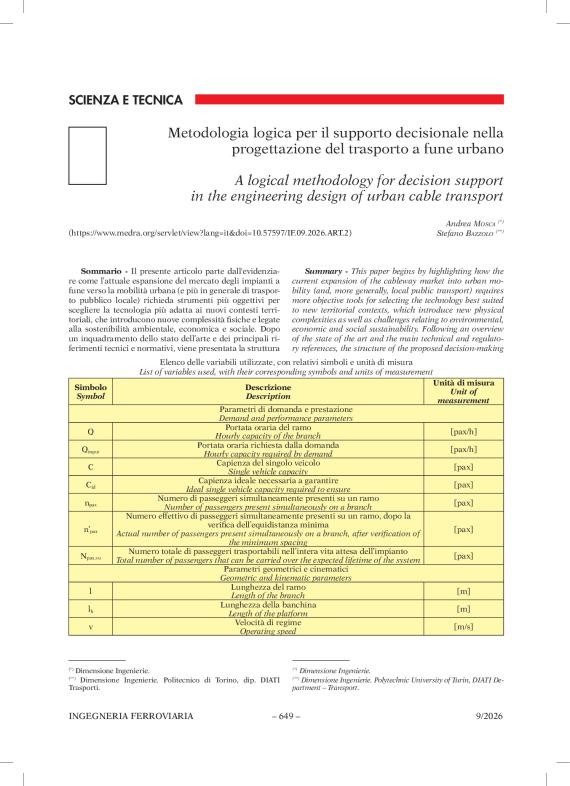
Summary - This paper begins by highlighting how the current expansion of the cableway market into urban mobility (and, more generally, local public transport) requires more objective tools for selecting the technology best suited to new territorial contexts, which introduce new physical complexities as well as challenges relating to environmental, economic and social sustainability. Following an overview of the state of the art and the main technical and regulatory references, the structure of the proposed decision-making model is presented, based on three levels of analysis. The first operational chapter concerns the capacity layer, which compares the main cableway technologies in terms of line length and required hourly capacity, defining their eligibility criteria. The second chapter examines the configuration layer, dedicated to contextualising technological solutions within the territory using operational GIS tools and line calculation tools. The third chapter describes the impact layer, in which alternatives are assessed using a multi-criteria analysis based on economic, environmental and social aspects. Finally, the paper presents applications to real-world case studies, analyses the results obtained and concludes by highlighting the method’s potential and limitations.
https://www.medra.org/servlet/view?lang=it&doi=10.57597/IF.09.2026.ART.2
- Settembre
